Machu Picchu travel guide 2026: everything you need to know
Machu Picchu is the reason many people travel to Peru, and it lives up to the expectation. But a visit needs more planning than most sights: a train or a trek, a timed ticket on a fixed circuit, a bus up the mountain and a licensed guide. This guide brings it all together in one place, with links to our detailed articles on each topic.
Machu Picchu in brief
| Fact | Detail |
|---|---|
| Altitude | 2,430 m — about 1,000 m lower than Cusco |
| Built | Around 1450, during the reign of the Inca Pachacuti |
| Known worldwide since | 1911, after Hiram Bingham’s expedition |
| Status | UNESCO World Heritage Site (1983) and one of the New Seven Wonders (2007) |
| Nearest town | Aguas Calientes (Machu Picchu Pueblo), 25–30 minutes by bus |
| From Cusco | About 3.5–4 hours by road and train |
A short history
Machu Picchu was built in the 15th century as a royal estate and religious centre for the Inca emperor Pachacuti, on a ridge between two peaks above the Urubamba River. It was used for less than a century: after the Spanish conquest it was gradually abandoned, and the Spanish never found it. Local farmers always knew of it, but it became world-famous in 1911, when the American explorer Hiram Bingham was guided there and published photographs of the overgrown city. Its precise stonework — walls built without mortar, designed to move rather than fall during earthquakes — still amazes engineers today.
Plan your Machu Picchu visit
Train, bus, entrance and guide booked for you — day tours from US $375.
What you will see inside
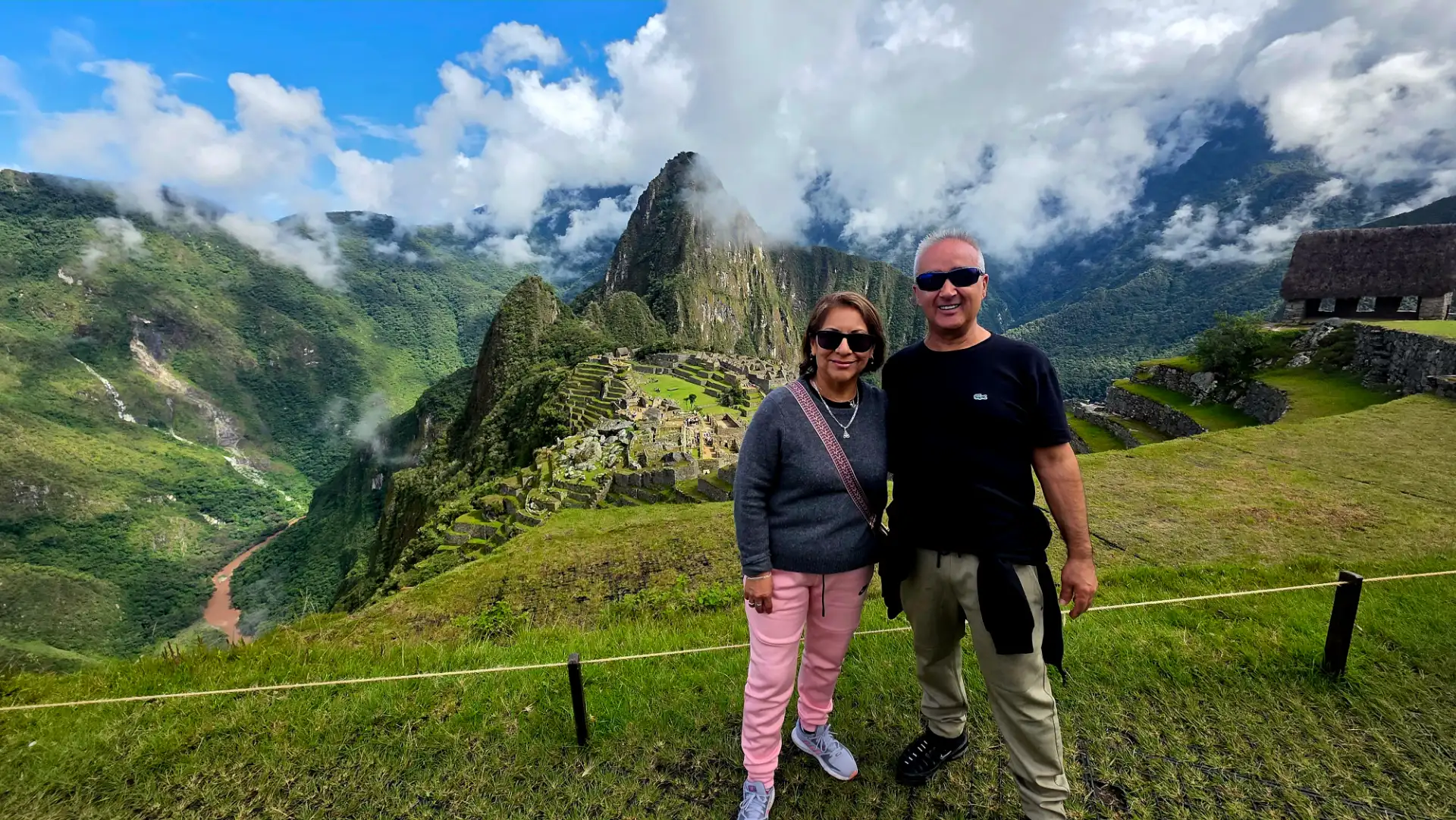
- The upper viewpoint: the postcard view over the whole city with Huayna Picchu behind.
- The agricultural terraces: hundreds of stone platforms that fed the city and protected the slopes.
- The Temple of the Sun: a curved tower aligned with the June solstice sunrise.
- The Temple of the Three Windows and the Main Temple, around the Sacred Plaza.
- The Intihuatana: a carved stone linked to astronomical observation.
- The Temple of the Condor: natural rock shaped into the wings of a condor.
What you see depends on your ticket: since 2024 visits follow fixed one-way circuits. Our tickets and circuits guide explains which one includes what. For more curiosities, read our Machu Picchu facts.

How to get there
There is no road to the citadel: everyone arrives in Aguas Calientes by train (usually from Ollantaytambo), on foot along the Inca Trail or another trek, or via the budget route by car to Hidroeléctrica and a walk along the railway. A shuttle bus then climbs to the entrance. Compare every option, with times and prices, in how to get to Machu Picchu.
Tickets: book early
Entry is by named, timed ticket on a fixed circuit, with daily limits. For a first visit we recommend Circuit 2 (Classic), which combines the upper viewpoint with the main temples. Huayna Picchu and Machu Picchu Mountain are booked as separate routes and sell out first. For June to August, book two to three months ahead.
When to go
The dry season, May to September, gives the clearest skies but the biggest crowds; April and October are a great compromise, and the rainy season (November to March) is green and quiet. The Classic Inca Trail closes every February, but Machu Picchu is open all year. See our month-by-month guide.
How many days do you need?
- One day: perfectly possible from Cusco with our Machu Picchu day tour (from US $375) — a long but well-organised day.
- Two days: more relaxed, with a night in Aguas Calientes or the Sacred Valley, as on our Sacred Valley + Machu Picchu 2-day tour.
- Four days or more: walk in on the Classic Inca Trail, the Salkantay or the Lares trek.
Plan at least two days in Cusco before any trek to acclimatize. Our article on how many days to spend in Cusco includes sample itineraries.
What to bring
- Your original passport — it must match your ticket.
- A small daypack; large bags are not allowed inside.
- Rain jacket, sunscreen, hat and insect repellent in every season.
- Water in a reusable bottle and comfortable shoes with grip for the stone steps.
- Some cash for the toilets at the entrance and snacks in Aguas Calientes.
Tripods, drones and food are not permitted inside. See what to wear to Machu Picchu.
Our insider tips
- Acclimatize in Cusco first, even though Machu Picchu is lower — the journey starts very early.
- Use the toilets before you enter; there are none inside.
- Listen to your guide in the first hour, then take your time for photos within your circuit.
- Have a plan B for clouds: morning mist often clears within an hour.
- Is it worth it? Read our honest take in is Machu Picchu worth it.
Frequently asked questions
By road to Ollantaytambo and train to Aguas Calientes, then a bus to the entrance — about 3.5 to 4 hours in total. You can also walk in on the Inca Trail or another trek.
Yes. Our day tour leaves Cusco at 4:30 AM and returns around 9:30 PM, with train, bus, entrance and a guided visit.
Yes. Tickets are limited per day and per circuit. Book two to three months ahead for June to August, and earlier for Huayna Picchu.
No. Machu Picchu is at about 2,430 m, roughly 1,000 m lower than Cusco.
Most guided visits last about two to three hours, depending on the circuit, plus extra time if your ticket includes Huayna Picchu or Machu Picchu Mountain.
The Incas, around 1450, as a royal estate for the emperor Pachacuti.