Train to Machu Picchu: PeruRail vs Inca Rail, every class, prices and timetables (2027)
There is no road to Aguas Calientes, the town at the foot of Machu Picchu. Unless you hike the Inca Trail or take the long detour by car via Hidroeléctrica, you will arrive by train. Two companies run it, PeruRail and Inca Rail, with seven classes between them. Prices range from about US $60 to more than US $500 one way. This guide compares every class, the stations, journey times, luggage rules and real prices. It also explains when to book and the mistakes we see travellers make every week. We book these trains daily for our own tours, so the advice is practical, not theoretical.
The quick answer
For most travellers the best value is PeruRail Vistadome or Inca Rail 360° from Ollantaytambo, with panoramic windows and the best views of the Urubamba gorge. Travel there the day before and sleep in Aguas Calientes, so you can enter Machu Picchu early. If you are on a tight budget, the basic classes (Expedition or The Voyager) make the same journey on the same track for less.
How the route works: stations and the last leg
The railway follows the Urubamba River from the high Andes down into the cloud forest. You can board at three places, and in all cases you get off at Machu Picchu Pueblo station, in Aguas Calientes.
| Station | Where it is | Time to Aguas Calientes | Notes |
|---|---|---|---|
| Poroy (Cusco) | 20–30 min by taxi from central Cusco | ≈ 3 h 15 – 3 h 45 | Fewest departures. In the rainy months operators often switch to a bus + train service via Ollantaytambo. |
| Ollantaytambo | Sacred Valley, 1 h 45 – 2 h by road from Cusco | 1 h 30 – 1 h 50 | The main hub, with the most departures and the widest range of times. |
| Urubamba | Sacred Valley | ≈ 2 h 30 | Only a few departures a day; handy if you sleep in Urubamba. |
From Aguas Calientes, the official Consettur bus climbs the zig-zag road to the entrance of the citadel in about 25–30 minutes (around US $12 each way, US $24 round trip for foreign adults). Buy it in town the day before, or online. The alternative is the stairs on foot: about 1 h 30 uphill from the Puente Ruinas bridge. Most people walk down and take the bus up.
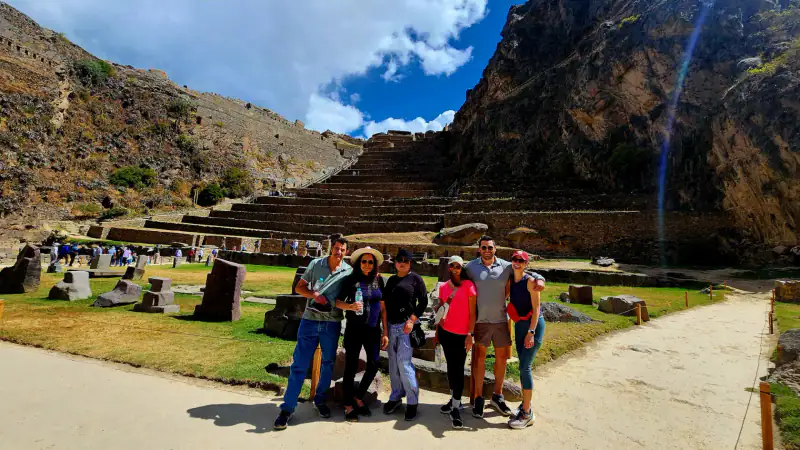
The smartest plan for many travellers is to combine the train with the Sacred Valley: tour Pisac and Ollantaytambo in the morning, then take an afternoon train from Ollantaytambo. That is exactly what our Sacred Valley and Machu Picchu 2-day tour does, and it is lower and gentler on your body than starting in Cusco. Compare the options in Sacred Valley to Machu Picchu routes.
Every train class compared
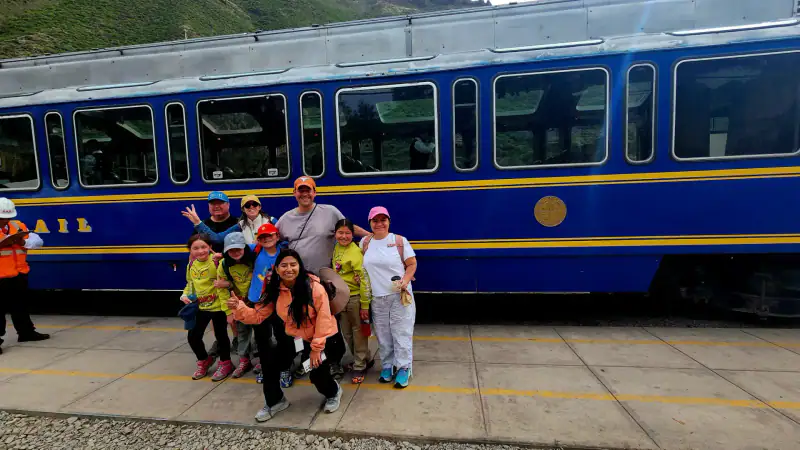
All trains use the same single track and take almost the same time. What changes is the window size, comfort, food on board and entertainment.
| Company | Class | What you get | Approx. one way* | Best for |
|---|---|---|---|---|
| PeruRail | Expedition | Comfortable seats, large windows and roof windows; snacks for purchase | US $60–90 | Best value, backpackers |
| PeruRail | Vistadome | Panoramic side and roof windows, snack and drink included, music and dance show on the return | US $85–130 | Most travellers |
| PeruRail | Vistadome Observatory | Vistadome plus an open-air observation car and a pisco experience | US $150–230 | Views and photos |
| PeruRail | Hiram Bingham (Belmond) | Luxury 1920s-style carriages, brunch or dinner with wine, live music, bus and entrance included | From ≈ US $500+ | Special occasions |
| Inca Rail | The Voyager | Basic class with large windows; snack and drink | US $60–90 | Best value |
| Inca Rail | The 360° | Panoramic windows and an open-air balcony car | US $80–130 | Views, good value |
| Inca Rail | The First Class / Prime | Premium seats, gourmet menu, bar, observatory car; bus included on First Class | From ≈ US $250+ | Comfort |
The difference between the two companies is small. PeruRail runs more departures and the luxury Hiram Bingham. Inca Rail often has competitive prices, a generous luggage allowance and an open-air car on The 360°. Compare live fares on the official sites of PeruRail and Inca Rail.
Which class should you choose?
| Your priority | Choose | Why |
|---|---|---|
| Lowest price | Expedition or The Voyager | Same track, same time, a little less glass and service |
| Best views for the money | Vistadome or The 360° | Roof windows or an open car through the canyon |
| Photos in the open air | Vistadome Observatory or The 360° | Open observation cars |
| A once-in-a-lifetime treat | Hiram Bingham | Fine dining, live music and everything included |
| Day trip from Cusco | Any class early morning; Vistadome back | Arrive early, relax on the way home |
On the way there in the morning, many people doze off. On the way back the views are partly dark after sunset in the rainy months. The best moment to pay for the panoramic class is a daytime journey through the canyon, usually the outbound trip from Ollantaytambo.
Timetables: when the trains run
Both companies publish their timetables online and change them by season. The pattern is stable from year to year:
| Time of day | From Ollantaytambo | From Aguas Calientes | Typical use |
|---|---|---|---|
| Very early (≈ 4:30–6:30 AM) | First departures | — | Same-day visit, early entry slot |
| Morning (≈ 7:00–11:00 AM) | Most departures | A few | Midday entry or overnight in Aguas Calientes |
| Afternoon (≈ 12:00–5:00 PM) | Several | Most returns | Sacred Valley tour + train, or return after the visit |
| Evening (≈ 6:00–9:30 PM) | Last trains | Last returns | Day trippers going home |
Here is how a typical one-day visit from Cusco fits together, based on our Machu Picchu day tour (from US $375):
| Time | Step |
|---|---|
| ≈ 4:30 AM | Pickup at your hotel in Cusco, drive to Ollantaytambo |
| ≈ 6:30 AM | Train to Aguas Calientes |
| ≈ 8:30 AM | Bus up to the citadel |
| ≈ 9:00 AM–12:00 PM | Guided visit of your circuit |
| Afternoon | Lunch and free time in Aguas Calientes |
| ≈ 3:00–5:00 PM | Train back to Ollantaytambo |
| ≈ 9:30 PM | Drop-off in Cusco |
It is a long day. If you can, stay one night: our Machu Picchu 2-day tour (from US $425) includes a hotel in Aguas Calientes, and the morning entry is much calmer.
How to book the train step by step
- Book your Machu Picchu entrance first. The circuit and time slot decide which train you need, and tickets sell out sooner than trains. Use the official tuboleto.cultura.pe or book through a tour. See tickets and circuits.
- Choose your station. Ollantaytambo gives the most options. Remember that you need 1 h 45 – 2 h by road from Cusco to reach it.
- Leave a margin. Arrive in Aguas Calientes at least 1 h 30 before your entry time (bus queue + ride).
- Book on the official site with your passport details exactly as they appear in your passport. Your name and passport number are checked when you board.
- Print or download the ticket and carry the same passport you used to book.
| Season | Months | Book the train | Book the Machu Picchu ticket |
|---|---|---|---|
| High | June–August, Easter, late December | 1–2 months ahead | 1–3 months ahead |
| Shoulder | April–May, September–October | 2–4 weeks ahead | 3–6 weeks ahead |
| Low | November–March | 1–2 weeks ahead | 2–4 weeks ahead |
In the wettest months (roughly January to April), the direct trains from Poroy are often replaced by a bus + train combination via Ollantaytambo, and heavy rain can occasionally delay trains. Keep a buffer day before an international flight. See Cusco in the rainy season.
Luggage rules and what to bring
| PeruRail | Inca Rail | |
|---|---|---|
| Hand luggage | One bag or backpack, about 5 kg (11 lb) | About 8 kg (17.6 lb) |
| Size | Up to about 157 cm (62 in) in total | Similar; check your class |
| Big suitcases | Not allowed on board; leave them at your hotel in Cusco | Same |
Leave your main luggage at your Cusco hotel (almost every hotel stores it for free) and travel with a small backpack. Bring your passport, a rain jacket, sunscreen, insect repellent for Aguas Calientes, water and some cash in soles for the bus and lunch. Food and large backpacks are not allowed inside the citadel itself, so a 20-litre daypack is ideal. Our guide on what to wear to Machu Picchu has the full list.
Alternatives to the train
| Option | How it works | Time | From | Good for |
|---|---|---|---|---|
| By car via Hidroeléctrica | Minivan to Hidroeléctrica (≈ 6 h), then 2.5–3 h walk along the tracks | 2 days | US $209 | Budget travellers |
| Short Inca Trail | Train to km 104, hike via Wiñay Wayna to the Sun Gate | 2 days | US $585 | A taste of the trail |
| Classic Inca Trail | Four days on foot, permits required | 4 days | US $820 | The full experience |
| Salkantay Trek | Mountain pass at 4,600 m, ends with the train back | 3–4 days | US $470 | Hikers without permits |
Even on the Inca Trail and Salkantay you usually return by train, so it is worth knowing the classes either way. For a full comparison of every route, read how to get to Machu Picchu and Inca Trail or train?. The budget route is explained in Machu Picchu by car via Hidroeléctrica.
On your own or with a tour?
| Item | On your own (approx.) | In our day tour |
|---|---|---|
| Transfer Cusco ⇄ Ollantaytambo | US $15–30 | Included |
| Train round trip (basic or panoramic) | US $120–260 | Included |
| Bus up and down | ≈ US $24 | Included |
| Machu Picchu entrance | ≈ US $45 | Included |
| Official guide at the site | US $15–25 per person (shared) | Included |
| Planning and coordination | Your time; sold-out risk | Done for you |
| Total | ≈ US $220–400 | From US $375 |
Doing it yourself is perfectly possible and can be cheaper with basic trains. A tour costs about the same as the panoramic classes bought separately. It also removes the hardest part: matching the train times with your entry slot when everything is selling out. See how much a trip to Machu Picchu costs.
What the journey is like, kilometre by kilometre
The ride is part of the experience. Leaving Ollantaytambo, the train runs beside the Urubamba with the snowy Nevado Verónica (5,682 m) on the skyline. Fields of maize give way to a narrow gorge, and the air gets warmer and greener with every kilometre.
| Point on the line | What you see | Why it matters |
|---|---|---|
| Ollantaytambo (km 68) | The Inca town and its terraces | Main departure station |
| Km 82 (Piscacucho) | Trekkers crossing the bridge | Start of the classic 4-day Inca Trail |
| Km 88 onwards | Inca terraces and the Llactapata area across the river | The valley narrows into a canyon |
| Km 104 | A small stop in the forest | Start of the 2-day Short Inca Trail |
| Last 20 minutes | Cloud forest, orchids, rapids, steep granite walls | The best views of the trip |
| Aguas Calientes (km 110) | The station by the market | Walk to the bus stop in 5–10 minutes |
On the panoramic trains, the crew points out these places. On the way back, the Vistadome adds a fashion show with alpaca garments and a traditional saqra dance, a fun way to end a long day. On the Inca Rail 360°, the open-air car is where the photos happen, so take your turn early.
Both companies offer reduced fares for children, with age limits that differ by operator and class, and very young children may travel on an adult’s lap. Check the rule for your class when you book, and bring each child’s passport: names are checked on board just like for adults.
Where to sleep: Aguas Calientes, Ollantaytambo or Cusco?
| Base | Pros | Cons | Best for |
|---|---|---|---|
| Aguas Calientes | First bus up, calm early entry, hot springs | Expensive for what you get, humid | Early entry slot, Huayna Picchu |
| Ollantaytambo | Lower, quiet Inca town, most trains | Few big hotels | Sacred Valley + Machu Picchu combos |
| Cusco | Your luggage stays put, more choice | Very early start, long day | Day trips, tight budgets |
If your entry slot is before 9:00 AM, sleep in Aguas Calientes. If it is after 11:00 AM, a morning train from Ollantaytambo works well. Our Aguas Calientes guide covers hotels, food and the hot springs.
7 mistakes to avoid
- Buying the train before the entrance ticket. If your slot sells out, you have a train to nowhere.
- Forgetting the road to Ollantaytambo. A 6:10 AM train from Ollantaytambo means leaving Cusco around 4:00 AM.
- Leaving too little time. The bus queue in Aguas Calientes can take 30–60 minutes in high season.
- Bringing a big suitcase. It will not be allowed on board.
- Misspelling your name or passport number. Changes cost money and time.
- Booking the last train back before a morning flight. Delays happen in the rainy season.
- Doing Rainbow Mountain the day after arrival and Machu Picchu after. Do it the other way round: see Machu Picchu and Rainbow Mountain itinerary.
Train, tickets and guide, all arranged
Machu Picchu day tour from Cusco with hotel pickup, round-trip train, bus, entrance and guide.
Frequently asked questions
One way, the basic classes (PeruRail Expedition, Inca Rail The Voyager) cost roughly US $60–90, the panoramic classes (Vistadome, The 360°) about US $80–130, and the luxury Hiram Bingham from about US $500. Prices change with the date and the hour.
Both are safe, punctual and use the same track. PeruRail has more departures and the luxury Hiram Bingham; Inca Rail often has competitive prices, an 8 kg luggage allowance and an open-air car on The 360°. Choose by time and price for your date.
From Poroy station near Cusco about 3 h 15 – 3 h 45. From Ollantaytambo, the main hub, about 1 h 30 – 1 h 50. Add 1 h 45 – 2 h by road from Cusco to Ollantaytambo.
No. The train ends in Aguas Calientes (Machu Picchu Pueblo). From there you take the Consettur bus for about 25–30 minutes, or walk up the stairs in about 1 h 30.
Yes. A typical day tour leaves Cusco around 4:30 AM and returns around 9:30 PM. It is long but very doable; staying one night in Aguas Calientes is more relaxed.
One to two months ahead for June to August and holidays, two to four weeks in the shoulder season and one to two weeks from November to March. Always book the Machu Picchu entrance first.
PeruRail allows one bag or backpack of about 5 kg; Inca Rail about 8 kg. Large suitcases are not allowed; leave them at your hotel in Cusco.
Usually yes, on a daytime journey from Ollantaytambo: the roof windows show the canyon and the snowy peaks. On an early-morning or night return, the basic class is just as good.