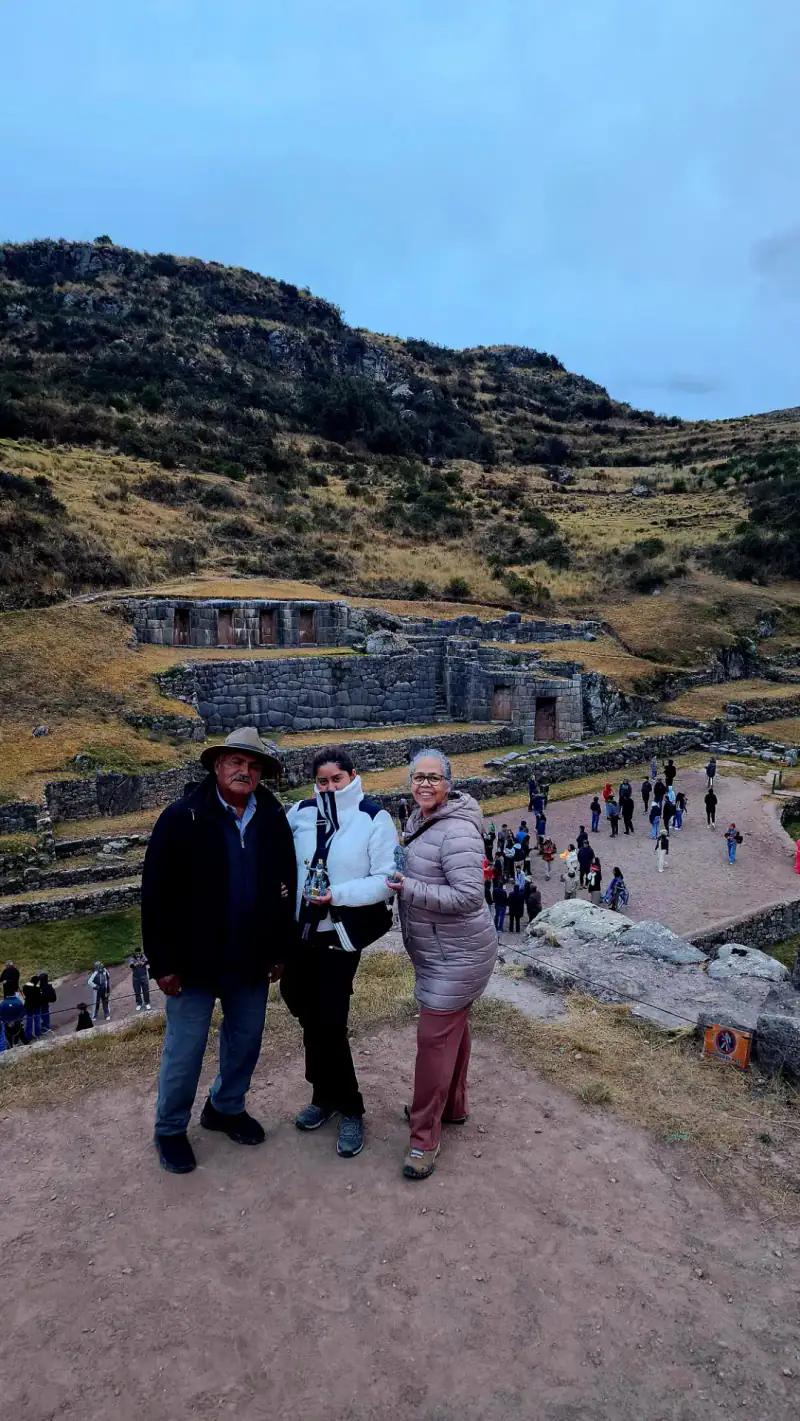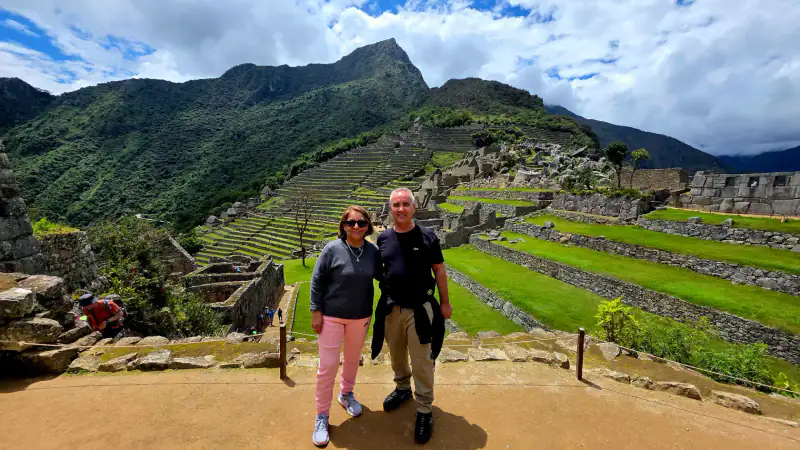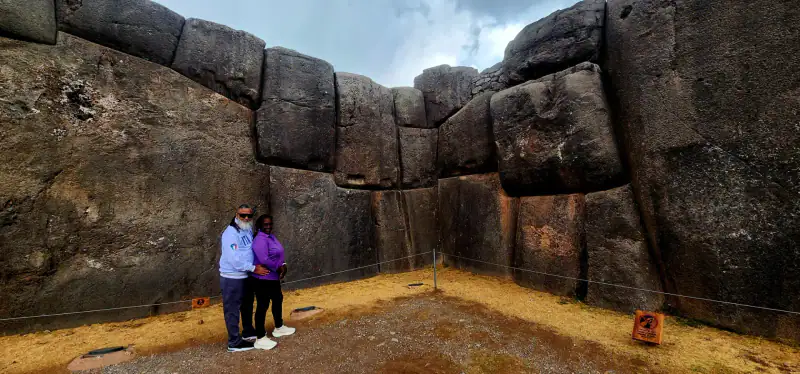
The history of the Inca Empire: from a small kingdom in Cusco to the largest state in the Americas
In less than a hundred years, a small highland kingdom centred on Cusco became the largest state the Americas had ever seen. At its peak, around 1530, the Inca Empire, which its people called Tawantinsuyu, “the four parts together”, ran for some 4,000 km along the Andes, from southern Colombia to central Chile. It had perhaps ten million subjects, a road network of about 30,000 km, and no money, no markets in the European sense and no alphabet. Then, within a single generation, it fell to a few hundred Spanish soldiers, a smallpox epidemic and a civil war. This guide tells the whole story in order: where the Incas came from, the 13 rulers, how the empire actually worked, what they believed, how they built, how it collapsed, and where you can still stand inside that history today, almost all of it within a day of Cusco.
The Inca Empire at a glance
| Date | What happened |
|---|---|
| c. 600–1000 | The Wari state rules much of the Peruvian Andes; it builds Pikillacta, 30 km south of Cusco |
| c. 1000–1200 | The Killke culture occupies the Cusco valley; the first stone buildings at Sacsayhuamán |
| c. 1200 | Traditional date for Manco Cápac founding the Kingdom of Cusco |
| c. 1438 | The Chanka attack Cusco; Prince Cusi Yupanqui defeats them and becomes Pachacuti |
| 1438–1471 | Pachacuti rebuilds Cusco and conquers the central Andes; Machu Picchu is built around 1450 |
| 1471–1493 | Túpac Inca Yupanqui pushes the empire into Ecuador, Bolivia, Chile and Argentina |
| 1493–1527 | Huayna Cápac rules from Cusco and Quito; the empire reaches its greatest size |
| c. 1527 | Huayna Cápac dies in an epidemic, probably smallpox, before the Spanish reach Peru |
| 1529–1532 | Civil war between his sons Huáscar and Atahualpa |
| 16 Nov 1532 | Francisco Pizarro captures Atahualpa at Cajamarca |
| 26 Jul 1533 | Atahualpa is executed; the Spanish enter Cusco in November |
| 1536–1537 | Manco Inca’s great rebellion: siege of Cusco, battles of Sacsayhuamán and Ollantaytambo |
| 1537–1572 | The Neo-Inca State resists from Vilcabamba |
| 24 Sep 1572 | Túpac Amaru, the last Inca, is executed in Cusco’s main square |
Strictly, Inca (Inka) was the title of the ruler and of the royal lineages of Cusco, not the name of a whole people. The ruler was the Sapa Inca, “the unique Inca”. Today the word is used for the empire, its culture and its ruling class, and we use it that way here.
Origins: the legends and what archaeology says
The Incas told two founding stories, and guides in Cusco still tell both. In the first, the Sun sent his children Manco Cápac and Mama Ocllo up from the waters of Lake Titicaca with a golden staff. Wherever the staff sank easily into the ground, they were to found a city. It sank in the valley of Cusco, and there Manco Cápac taught men to farm and Mama Ocllo taught women to spin and weave.
In the second, four brothers and four sisters, the Ayar siblings, emerged from a cave called Tambo Toco at Pacaritambo, south of Cusco. One by one the brothers were turned to stone or sealed back in the earth, until only Ayar Manco, the future Manco Cápac, reached the valley. One brother became the sacred rock of Huanacauri, a mountain shrine that the Incas visited for centuries.
Archaeology tells a slower story. The Cusco valley was farmed long before the Incas. From about 600 AD the Wari state, based near modern Ayacucho, controlled much of the Peruvian highlands; its walled city of Pikillacta, in the South Valley, is still impressive. Around Lake Titicaca, Tiwanaku dominated the southern Andes. When both declined around 1000 AD, the region broke into small rival chiefdoms. In the Cusco valley, archaeologists call the period and its pottery Killke (c. 1000–1400), and the first phases of Sacsayhuamán date from it.
The Incas were one of these chiefdoms. For two centuries they fought, married and allied with neighbours such as the Ayarmaca and the Pinagua. Their great achievement was not a single battle but a slow consolidation that, by the early 15th century, made Cusco the strongest power in the valley.
| Culture | Dates (approx.) | Where to see it near Cusco |
|---|---|---|
| Wari | 600–1000 AD | Pikillacta, South Valley (South Valley tour) |
| Tiwanaku | 500–1000 AD | Lake Titicaca region (Bolivian side) |
| Killke | 1000–1400 AD | Early walls at Sacsayhuamán; pottery in Cusco museums |
| Inca | 1200–1572 AD | Cusco, the Sacred Valley, Machu Picchu, Choquequirao and hundreds of sites |
The 13 Sapa Incas
Spanish chroniclers recorded a list of rulers from the memory of Inca nobles and khipu keepers. The first seven or eight are semi-legendary; from Viracocha Inca onwards the history becomes firmer, and from Pachacuti it is well documented. Each ruler founded a royal lineage, a panaca, which kept his palace, his lands and, after his death, his mummy, which was dressed, fed and consulted as if still alive.
| # | Sapa Inca | Reign (approx.) | Remembered for |
|---|---|---|---|
| 1 | Manco Cápac | c. 1200 | Legendary founder of Cusco |
| 2 | Sinchi Roca | 13th century | Consolidated the first settlement |
| 3 | Lloque Yupanqui | 13th century | Alliances with neighbouring groups |
| 4 | Mayta Cápac | 13th–14th century | Early wars in the Cusco valley |
| 5 | Cápac Yupanqui | 14th century | First raids beyond the valley |
| 6 | Inca Roca | 14th century | Founded the Hanan (upper) Cusco dynasty; his palace has the 12-angled stone |
| 7 | Yáhuar Huácac | 14th–15th century | Kidnapped as a child, a story chroniclers loved |
| 8 | Viracocha Inca | early 15th century | Built the estate of Huchuy Qosqo; fled the Chanka attack |
| 9 | Pachacuti | 1438–1471 | Defeated the Chanka, rebuilt Cusco, founded the empire, built Machu Picchu |
| 10 | Túpac Inca Yupanqui | 1471–1493 | The great conqueror: Ecuador, Bolivia, Chile, Argentina |
| 11 | Huayna Cápac | 1493–1527 | Ruled the empire at its peak, from Cusco and Quito |
| 12 | Huáscar | 1527–1532 | Lost the civil war to his half-brother |
| 13 | Atahualpa | 1532–1533 | Captured and executed by the Spanish |
Inca succession had no fixed rule such as “the eldest son inherits”. The ruler named the son he judged most able, ideally the son of his principal wife, the Coya. In practice, every death opened a struggle between royal lineages, and several reigns began with a war or a plot. That weakness would prove fatal in 1527.
Pachacuti and the birth of an empire
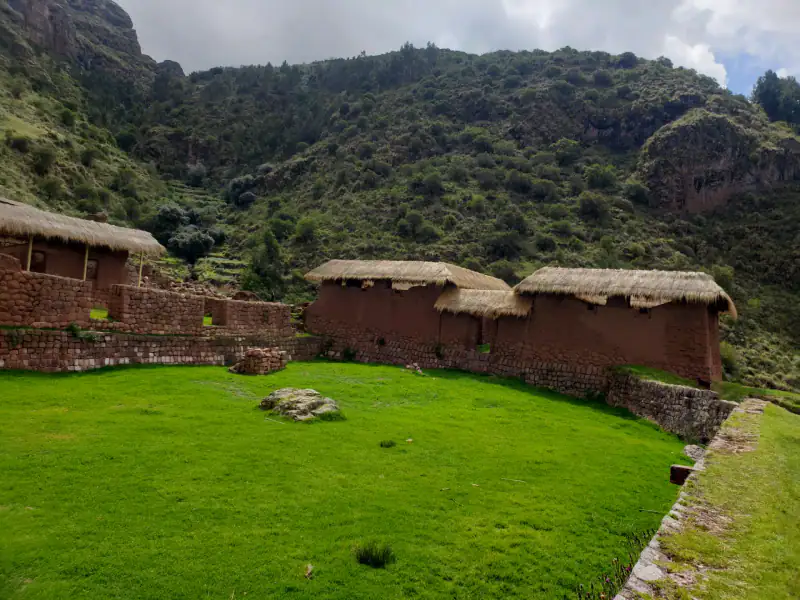
Around 1438 the Chanka, a powerful confederation from the west, marched on Cusco. The old ruler, Viracocha Inca, abandoned the city with his heir and withdrew to his estate. A younger son, Cusi Yupanqui, stayed, rallied the defenders and won. According to legend, the very stones of the field rose up as warriors to fight beside him, the pururaucas. Victory made him ruler, and he took the name Pachacuti, usually translated as “he who turns the world upside down” or “earth-shaker”.
Pachacuti did three things that changed everything. First, he rebuilt Cusco as an imperial capital of fine stone, with great plazas, palaces and the remodelled temple of the Sun, the Qoricancha. Chroniclers say the city was laid out in the shape of a puma, with Sacsayhuamán as its head; historians still debate how literal that was. Second, he turned raids into conquest: defeated peoples were not just looted but incorporated, with their lords kept in place under Inca governors. Third, he created the state religion and royal ideology that tied every province to the Sun and to Cusco.
He also built for himself. Royal estates were the private property of a ruler and his lineage, and Pachacuti’s include Machu Picchu, built around 1450, as well as parts of Pisac and Ollantaytambo. Machu Picchu was not a lost city or a secret fortress: it was a palace and religious retreat for the emperor’s household, staffed by a few hundred people.
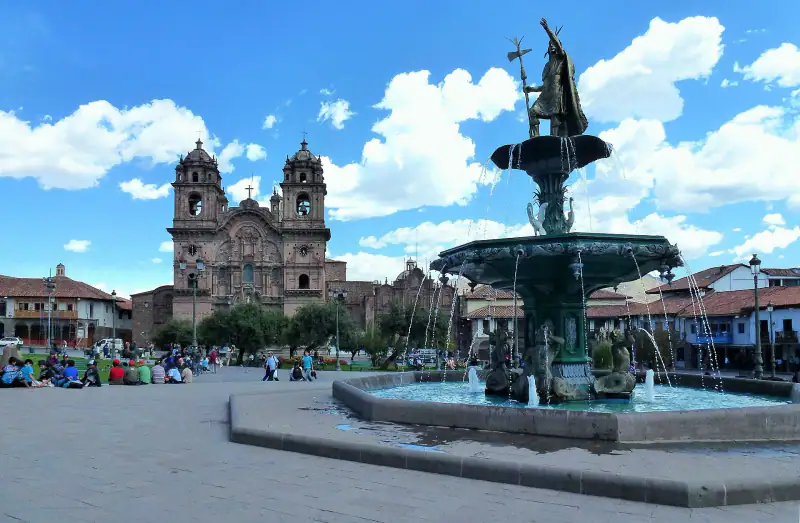
Túpac Inca Yupanqui and Huayna Cápac
Pachacuti’s son Túpac Inca Yupanqui was the empire’s greatest general. He conquered the Chimú kingdom on the north coast, whose capital Chan Chan was then the largest adobe city in the world. He pushed north into Ecuador and south deep into Bolivia, northwest Argentina and Chile as far as the Maule River. Chroniclers even record a sea voyage to distant islands, a story still argued over.
His son Huayna Cápac spent most of his reign in the north, fighting in Ecuador and southern Colombia and building a second capital at Tomebamba (modern Cuenca) and Quito. Under him the empire reached its peak. It was also overstretched: a ruler who spent decades away from Cusco, a nobility divided between north and south, and frontier wars that never really ended.
| Suyu (quarter) | Direction from Cusco | Main regions today | Landscape |
|---|---|---|---|
| Chinchaysuyu | Northwest | Central and northern Peru, Ecuador, southern Colombia | The richest and most populous quarter; coast and highlands |
| Antisuyu | Northeast | The eastern slopes and Amazon edge (Paucartambo, Vilcabamba) | Cloud forest and jungle; the word gave us “Andes” |
| Collasuyu | Southeast | Lake Titicaca, Bolivia, northwest Argentina, Chile | The largest quarter; high plains and deserts |
| Cuntisuyu | Southwest | Arequipa, Moquegua and the southern Peruvian coast | The smallest quarter; canyons and coast |
How the empire worked
The Inca state ran on a principle Andean peoples had practised for millennia: reciprocity and labour, not money. Families owed the state work, and the state, in return, fed workers during their service, threw feasts, stored food against famine and maintained roads and temples.
The ayllu
The basic unit of Andean life was the ayllu, an extended kin group that held land in common and shared work. Ayllus still exist in many highland communities around Cusco, and you can see the tradition of shared labour, ayni and minka, in villages on the road to Rainbow Mountain or in the Sacred Valley.
Mit’a: the labour tax
Every household owed periods of work, the mit’a: farming state and temple lands, building roads and terraces, serving in the army, carrying messages or working in mines. Land in each province was divided into three parts, for the Sun (religion), for the Inca (the state) and for the communities. The famous terraces of Pisac, Ollantaytambo and Moray are monuments to mit’a labour.
Storehouses
The state stored the harvest in thousands of qollqa (storehouses) built on cool, windy hillsides; you can see rows of them above Ollantaytambo. Freeze-dried potato (chuño) and dried meat (ch’arki, the origin of the word “jerky”) could last years. When the Spanish arrived they found storehouses still full of food, cloth and weapons.
Moving whole peoples
To secure new provinces, the Incas moved entire communities, the mitmaqkuna: loyal groups were settled in rebellious regions, and rebellious ones were moved to the heartland. It was an effective tool of control and one reason why the map of Andean languages and dress today is so mixed.
Quechua and khipus
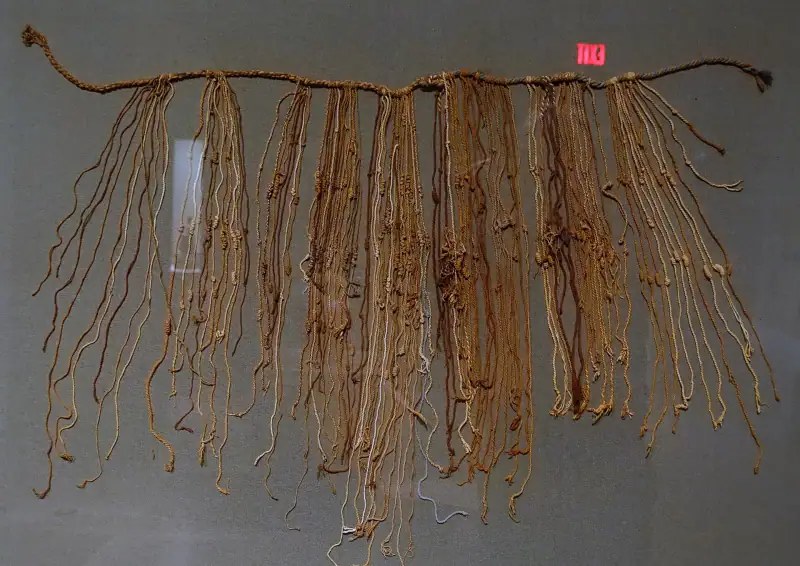
The Incas spread Quechua (runa simi, “the people’s language”) as the language of administration, and it is still spoken by millions of Peruvians. They had no alphabet, but they kept records on khipus, bundles of knotted cords. The type, position and colour of the knots recorded numbers in a decimal system: censuses, tribute, stores, calendars. Specialists called khipukamayuq could “read” them aloud. Whether khipus also recorded narrative, such as names and histories, is one of the great unsolved questions of Andean archaeology.
| Institution | What it was | What you can see today |
|---|---|---|
| Ayllu | Kin group holding land in common | Highland communities around Cusco |
| Mit’a | Rotating labour owed to the state | Terraces, roads and temples everywhere |
| Qollqa | State storehouses | Pinkuylluna, above Ollantaytambo |
| Mitmaqkuna | Resettled communities | Mixed dress and dialects across the Andes |
| Khipu | Knotted-cord records | Museums in Cusco, Lima and abroad |
| Quechua | Language of the state | Spoken daily in Cusco and the highlands |
Roads, chasquis and bridges
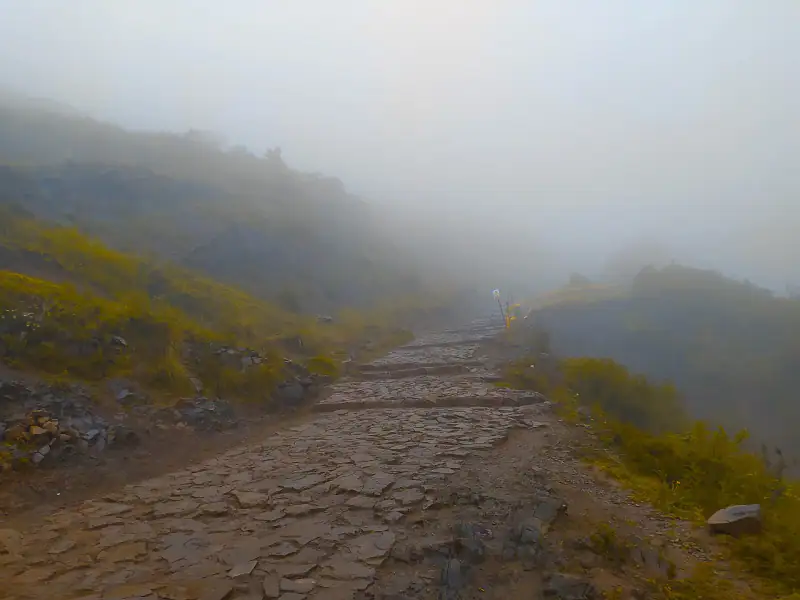
The Qhapaq Ñan, the “royal road”, held the empire together. Its two main trunks ran north–south, one through the highlands and one along the coast, linked by dozens of transversal routes, for a total of about 30,000 km. In 2014 UNESCO inscribed it as a World Heritage Site shared by six countries: Peru, Bolivia, Ecuador, Colombia, Chile and Argentina. The Inca Trail to Machu Picchu is only one short branch of it.
The Incas did not use the wheel for transport, and they had no horses. Roads were built for people and llama caravans: paved where needed, stepped on steep slopes, drained, and lined with walls. Every 20 km or so stood a tambo, a way station with lodging and stores, and along the road lived relay runners, the chasquis. Running in short stages and passing on spoken messages and khipus, they could carry news from Quito to Cusco, about 2,000 km, in roughly a week. Chroniclers say the emperor could eat fresh fish from the coast in Cusco.
Where the road met a canyon, the Incas built suspension bridges of woven grass. The last one, Q’eswachaka, still spans the Apurímac River four hours south of Cusco. Every June, four Quechua communities rebuild it by hand in three days, a tradition UNESCO added to its Intangible Heritage list in 2013. Crossing it is one of the most direct ways to touch Inca engineering.
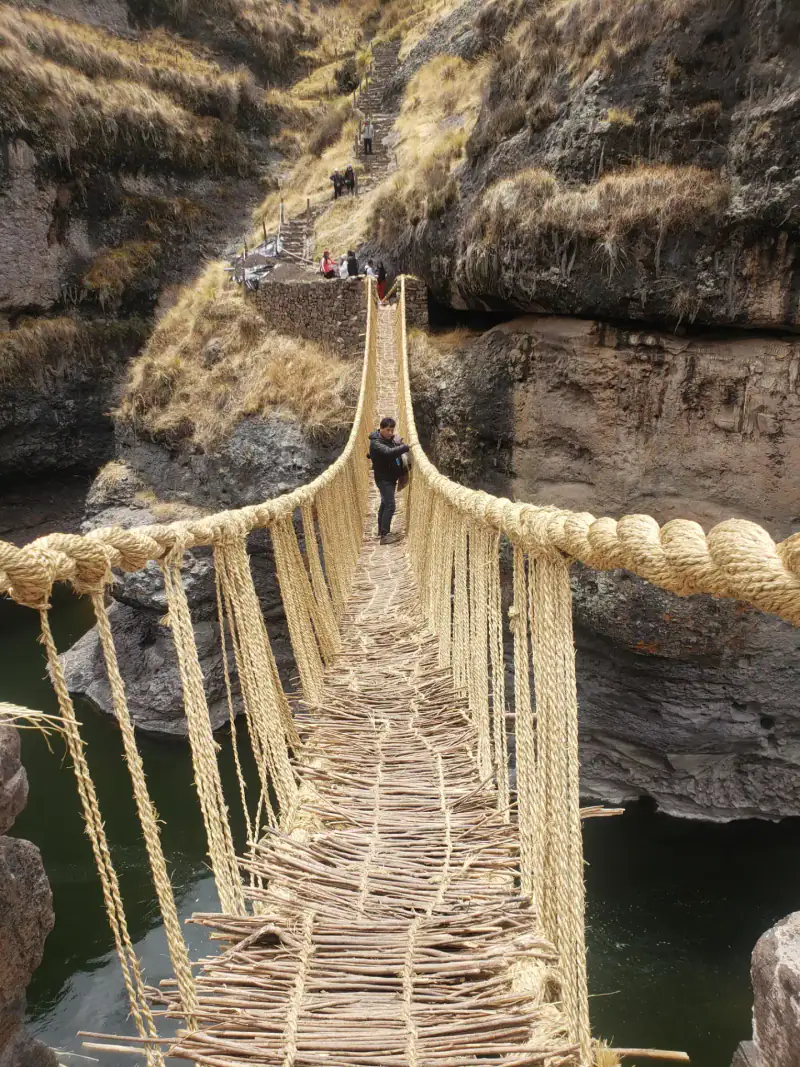
Walk on an Inca bridge
Our Q’eswachaka day trip from Cusco crosses the last Inca rope bridge and visits four highland lakes on the way, from US $40.
Religion and the Inca view of the world
Inca religion was not a single doctrine but layers of belief. At the top stood the state cult of Inti, the Sun, divine ancestor of the ruling dynasty; the Sapa Inca was the “son of the Sun”. Alongside him were Viracocha, the creator god; Mama Quilla, the Moon; Illapa, thunder and rain; and Pachamama, Mother Earth, who is still honoured today with offerings of coca leaves and chicha before planting or a journey.
Below the great gods was a landscape alive with sacred places, the huacas: springs, rocks, caves, tombs and, above all, mountains. The great snow peaks, the Apus, such as Ausangate and Salkantay, were powerful beings who controlled water and fertility. Your guide at Rainbow Mountain or Humantay Lake may still make a small offering to the Apus before the climb.
The Incas divided the world into three levels: Hanan Pacha, the upper world of the gods, symbolised by the condor; Kay Pacha, this world, symbolised by the puma; and Ukhu Pacha, the world below, of the dead and of seeds, symbolised by the snake. You will see the condor, puma and snake carved, painted and woven everywhere in Cusco.
The Qoricancha and the ceque system
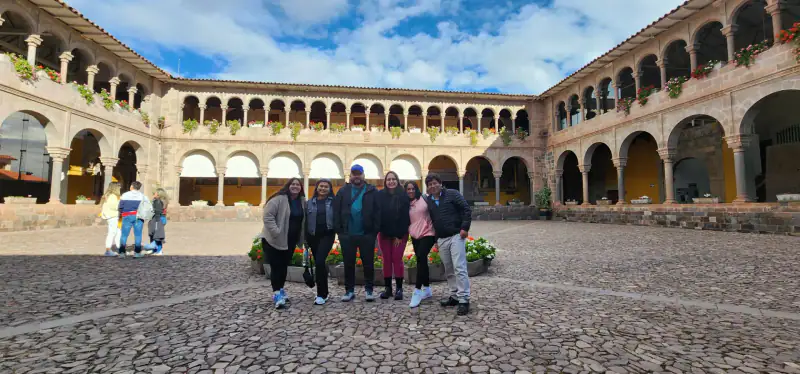
At the religious centre of the empire stood the Qoricancha, the “golden enclosure”, whose walls were lined with sheets of gold and whose garden held life-size plants and animals in gold and silver. From it radiated 41 imaginary lines, the ceques, linking some 328 huacas around the valley; each was looked after by a specific lineage. The Spanish melted the gold and built the convent of Santo Domingo on top, but the Inca walls survived the earthquakes that toppled the church.
Festivals, mummies and sacrifice
The ritual year followed the sun and the farming cycle. The greatest feast, Inti Raymi, was held at the June solstice, the start of the new year; it was revived in 1944 and is now staged every 24 June at Sacsayhuamán. Royal mummies took part in the festivals, carried in procession and given food and drink. In moments of crisis, the state performed capacocha, the sacrifice of carefully chosen children on high mountain summits; the best-known example is the frozen girl found on Mount Ampato, near Arequipa, in 1995.
| Deity or concept | What it represents | Where you meet it today |
|---|---|---|
| Inti | The Sun, ancestor of the Incas | Inti Raymi, 24 June, at Sacsayhuamán |
| Viracocha | The creator | Temple of Wiracocha at Raqchi |
| Pachamama | Mother Earth | Offerings (pagos) in August and before any journey |
| Apus | The sacred mountains | Ausangate, Salkantay, Huayna Picchu |
| Huacas | Sacred places | Q’enqo, Tambomachay, carved rocks around Cusco |
| Three worlds | Condor, puma, snake | Carvings, textiles and guides’ stories everywhere |
Architecture and engineering
The Incas are famous for stonework so precise that a knife blade will not fit between the blocks. Without iron tools, they shaped granite and andesite with harder hammerstones, ground the faces with sand and water, and fitted each block to its neighbours by trial and error. The finest walls, in temples and palaces, are made of polygonal or rectangular blocks laid without mortar. The 12-angled stone on Hatun Rumiyoc street in Cusco, part of the palace of Inca Roca, is the most photographed example.
That precision was also an earthquake strategy. Walls lean slightly inwards, doors and windows are trapezoidal, and the interlocking blocks can “dance” during a quake and settle back into place. In the earthquakes of 1650 and 1950, many colonial buildings in Cusco collapsed while the Inca walls beneath them stood.
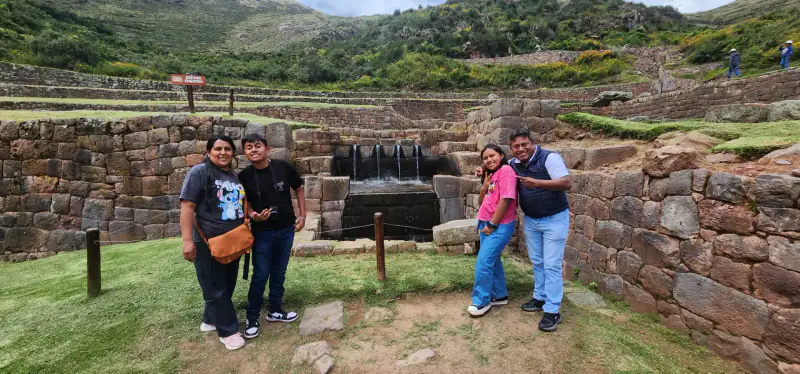
Inca engineers worked with the landscape rather than against it. Agricultural terraces (andenes) turned steep slopes into fields, with layers of stone, gravel and soil for drainage. Canals and fountains brought spring water across valleys; at Tipón they still run five centuries later. At Moray, circular terraces create small temperature differences between levels; many researchers believe the site was used to experiment with crops, though its exact purpose is debated.
| Site | Built for | Highlight | Distance from Cusco |
|---|---|---|---|
| Sacsayhuamán | Temple and ceremonial fortress | Zigzag walls with blocks of over 100 tonnes | 2 km |
| Qoricancha | Temple of the Sun | The finest masonry in the empire | In the city |
| Pisac | Royal estate of Pachacuti | Terraces and a ritual sector on a ridge | 33 km |
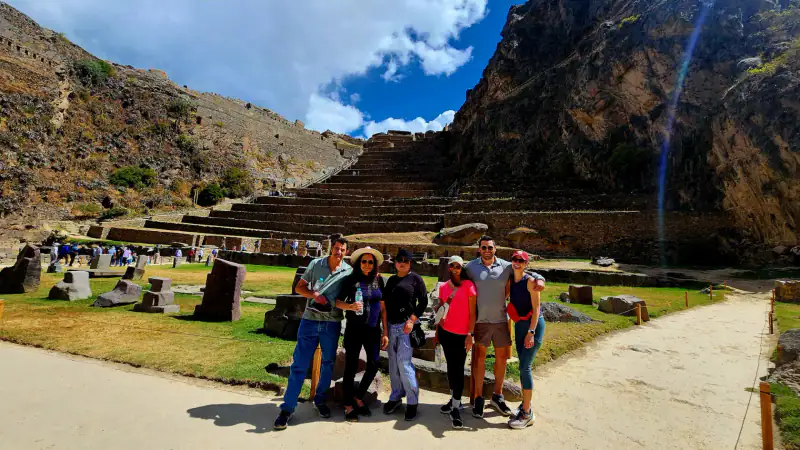
| Ollantaytambo | Royal estate and temple | Unfinished temple of monoliths; storehouses | 72 km |
| Moray | Agricultural or ceremonial site | Circular terraces like an amphitheatre | 50 km |
| Tipón | Royal estate and water garden | Canals and fountains still flowing | 25 km |
| Machu Picchu | Royal estate of Pachacuti | A complete Inca city on a ridge | 75 km (train) |
| Choquequirao | Later royal estate | Llama mosaics on terraces, few visitors | 4-day trek |
The fall: epidemic, civil war and Cajamarca
The Inca Empire did not fall because it was weak. It fell because three blows came together within a few years.
1. Disease. European diseases travelled down from Central America ahead of the Spanish. Around 1527 an epidemic, very probably smallpox, swept through Ecuador and killed Huayna Cápac and, according to most chroniclers, his chosen heir. Millions of Andean people would die from epidemics in the following decades.
2. Civil war. With no agreed successor, the empire split. Huáscar was crowned in Cusco; his half-brother Atahualpa held the veteran northern army in Quito. Between about 1529 and 1532 they fought a ruthless war. Atahualpa’s generals won, captured Huáscar and massacred much of his lineage in Cusco.
3. The Spanish. In 1532 Francisco Pizarro landed on the north coast with fewer than 200 men. Atahualpa, fresh from victory, agreed to meet them at Cajamarca. On 16 November 1532, as the Inca entered the square on his litter with thousands of unarmed attendants, the hidden Spanish attacked with guns, cannon and horses. Thousands were killed in a few hours and Atahualpa was taken prisoner.
To buy his freedom, Atahualpa offered to fill a room once with gold and twice with silver. The ransom arrived from all over the empire, and most of it was melted down. Pizarro executed him anyway, on 26 July 1533. Atahualpa had also ordered Huáscar killed from captivity. In November 1533 the Spanish, with many native allies who hated Inca rule, entered Cusco.
Historians stress the native allies: the Cañari, the Chachapoya, the Huanca and many others saw the Spanish as a chance to free themselves from Cusco, and tens of thousands fought on their side. Add steel, horses, a civil war that had just ended, and epidemics, and the conquest becomes less mysterious.
Manco Inca and the Vilcabamba resistance
The Spanish crowned a young son of Huayna Cápac, Manco Inca, as a puppet ruler. Humiliated and abused, he escaped in 1536 and raised an army of perhaps 100,000 men. His forces besieged Cusco for months and set the thatched roofs of the city on fire. The Spanish fought their way up to Sacsayhuamán and took it in a bloody battle in which Juan Pizarro, Francisco’s brother, was killed.
In 1537, at Ollantaytambo, Manco won the one great Inca victory of the war: his men held the terraces and flooded the plain below by diverting the river, forcing the Spanish cavalry to retreat. But the siege had failed, and Manco withdrew into the deep valleys of Vilcabamba, northwest of Cusco.
There, for 35 years, the Neo-Inca State survived: an independent Inca kingdom with its own court, temples and raids on the Spanish roads. Manco was murdered in 1544 by Spanish fugitives he had sheltered. His sons Sayri Túpac, Titu Cusi Yupanqui and Túpac Amaru ruled after him. In 1572 the viceroy Francisco de Toledo sent an army; Vilcabamba was taken and Túpac Amaru, the last Inca, was brought to Cusco and beheaded in the main square on 24 September 1572.
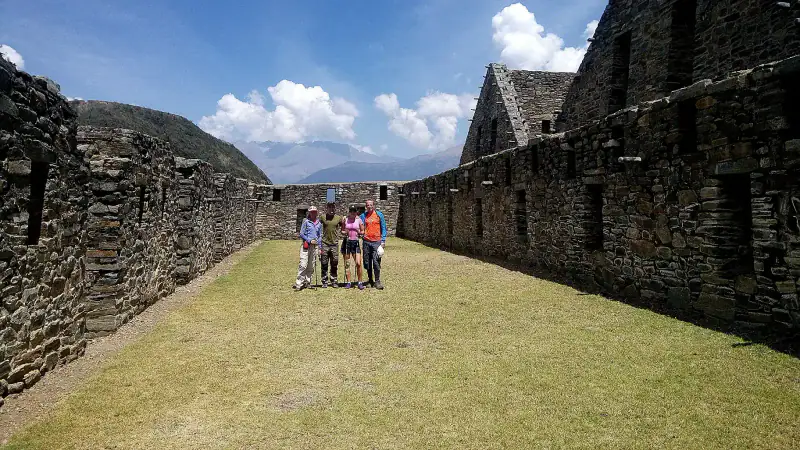
The ruins of Vilcabamba, at Espíritu Pampa, were identified in the 1960s. Remote sites linked to this period, such as Vitcos and Choquequirao, can still only be reached on foot.
The memory of the Incas did not die in 1572. In 1780, José Gabriel Condorcanqui, a descendant of the Inca nobility, took the name Túpac Amaru II and led the largest indigenous rebellion in colonial history. He too was executed in Cusco’s square, in 1781. His name is still a symbol of resistance in Peru.
Where Machu Picchu fits in the story
Machu Picchu was built around 1450, most likely for Pachacuti, and was used for less than a century. It lay off the main roads and, as far as we know, the Spanish never found it, which is why it survived so complete. It was not forgotten by local farmers, who knew it well. In July 1911 the Yale lecturer Hiram Bingham was guided there by Melchor Arteaga, a farmer from the valley, and found families living and farming on the terraces. Bingham believed he had found Vilcabamba, the last Inca refuge; he was wrong, but his photographs made Machu Picchu world-famous.
Today Machu Picchu is a UNESCO World Heritage Site (1983) and one of the New Seven Wonders of the World. Visits follow fixed circuits with timed tickets, so book early: see our guide to tickets and circuits and the 15 facts about Machu Picchu.
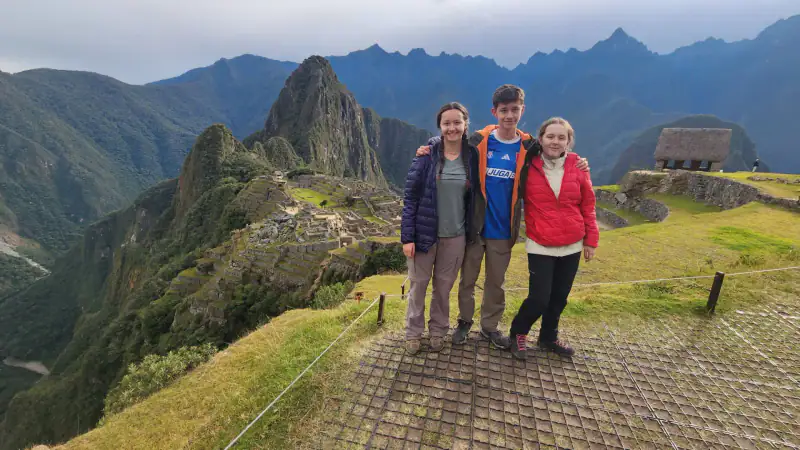
See Machu Picchu with a local guide
Full-day tour from Cusco by train with guide, bus and entrance, or take two days and stay in Aguas Calientes.
The Inca legacy today
The empire lasted barely a century, but its heirs are everywhere in Peru. Quechua is an official language of Peru and the mother tongue of roughly 14% of Peruvians, according to the 2017 census; in Cusco you will hear it in markets, on buses and on the radio. Andean farming still uses Inca terraces, Inca crops such as potatoes, quinoa and maize, and Inca ideas of working the land together. Peru grows thousands of potato varieties, many of them domesticated long before the Incas.
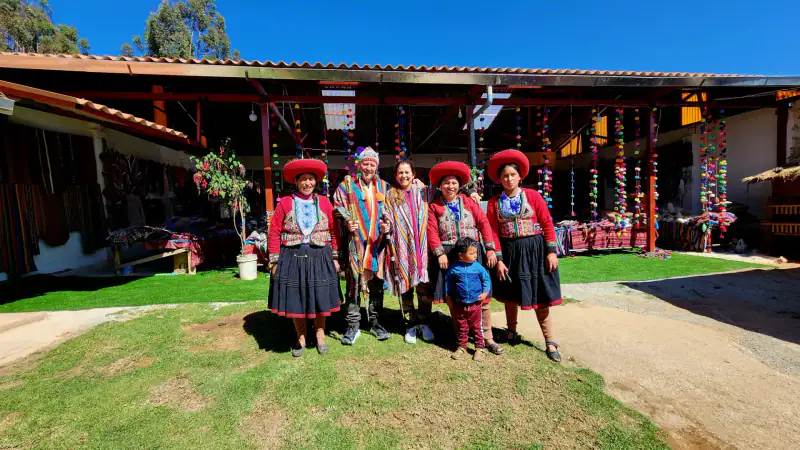
Inca festivals live on, mixed with Catholic ones: Inti Raymi in June, the Qoyllur Rit’i pilgrimage to a glacier near Ausangate, the yearly renewal of the Q’eswachaka bridge, and the August offerings to Pachamama. Textiles from Chinchero and Pisac still use Inca-era symbols and natural dyes. Peru’s constitution names Cusco the historic capital of Peru, and the city’s flag is the rainbow banner associated with Tawantinsuyu.
| Inca legacy | Today |
|---|---|
| Quechua (runa simi) | Spoken by millions in Peru, Bolivia and Ecuador |
| Terraces and canals | Still farmed in the Sacred Valley and the South Valley |
| Potatoes, quinoa, maize | Staples of Peruvian food; see our Peruvian food guide |
| Inti Raymi | Staged every 24 June at Sacsayhuamán |
| Ayni and minka | Shared community work in highland villages |
| Inca stonework | The foundations of central Cusco |
Where to see Inca history around Cusco
Almost every chapter of this story has a place you can visit from Cusco. Here is how they fit together, with the tours that cover them.
| Chapter of the story | Place | How to visit | Price from |
|---|---|---|---|
| Before the Incas | Pikillacta (Wari) | South Valley tour | US $35 |
| The capital | Qoricancha, Sacsayhuamán, Q’enqo, Tambomachay | Cusco city tour | US $18 |
| Royal estates | Pisac, Ollantaytambo, Chinchero | Sacred Valley tour | US $35 |
| Agriculture | Moray and the Maras salt pans | Maras and Moray tour | US $30 |
| Viracocha Inca | Huchuy Qosqo | Huchuy Qosqo day trek | US $130 |
| Roads and bridges | Q’eswachaka | Q’eswachaka tour | US $40 |
| A frontier fortress | Waqrapukara | Waqrapukara tour | US $50 |
| Pachacuti’s masterpiece | Machu Picchu | Machu Picchu day tour | US $375 |
| The royal road | Inca Trail to Machu Picchu | Classic Inca Trail 4 days | US $820 |
| The last refuges | Choquequirao | Choquequirao trek 4 days | US $395 |
A five-day “history in order” plan
- Day 1, Cusco. City tour: Qoricancha, the cathedral built on the palace of Viracocha, Sacsayhuamán, Q’enqo and Tambomachay. In the evening, walk Hatun Rumiyoc to the 12-angled stone.
- Day 2, before and around the Incas. South Valley: Tipón’s water garden, the Wari city of Pikillacta and the colonial church of Andahuaylillas, built on an Inca site.
- Day 3, the royal estates. Sacred Valley: Pisac, the Urubamba valley and Ollantaytambo, where Manco Inca beat the Spanish.
- Day 4, Machu Picchu. Train from Ollantaytambo and a guided visit of Pachacuti’s estate.
- Day 5, the road. Q’eswachaka bridge, or Moray and Maras if you prefer a shorter day.
All Cusco sites except the Qoricancha, the cathedral and Machu Picchu are covered by the Boleto Turístico. Cusco sits at 3,400 m, so keep the first day gentle: see our altitude guide. For more on individual sites, read the 12 best Inca sites in Cusco.
Build your own Inca history trip
Tell us your dates and interests and we will combine the city, the valleys, Machu Picchu and the remote sites into one itinerary.
Frequently asked questions
The Incas were the ruling dynasty of Cusco, in the Peruvian Andes, who between about 1438 and 1532 built the largest empire in the pre-Columbian Americas, Tawantinsuyu, stretching from southern Colombia to central Chile.
The Kingdom of Cusco existed from around 1200, but the empire proper lasted under a century, from Pachacuti’s rise around 1438 to the capture of Atahualpa in 1532. An independent Neo-Inca State survived in Vilcabamba until 1572.
Cusco. It was the political and religious centre where the four quarters of the empire met. Huayna Cápac also used Quito and Tomebamba as northern capitals.
Pachacuti, the ninth Sapa Inca, who defeated the Chanka around 1438, rebuilt Cusco, began the great conquests and built Machu Picchu. His son Túpac Inca Yupanqui conquered the largest territory.
The empire had just been devastated by a smallpox epidemic and a civil war between Huáscar and Atahualpa. The Spanish captured Atahualpa by surprise at Cajamarca and were helped by tens of thousands of native allies who resented Inca rule.
They had no alphabet, but they kept detailed records on khipus, knotted cords that stored numbers in a decimal system. Whether khipus also recorded words or stories is still being researched.
Quechua, which they spread as the language of administration. It is still spoken by millions of people in Peru, Bolivia and Ecuador and is an official language of Peru.
There is no record that they did, which is one reason it survived so well. Local farmers always knew it; Hiram Bingham made it internationally known in 1911.
Cusco and its surroundings: the Qoricancha, Sacsayhuamán, the Sacred Valley, Machu Picchu and smaller sites such as Tipón, Huchuy Qosqo and Q’eswachaka. A good local guide makes a big difference.
Photos from Wikimedia Commons: khipu, Photo: Daderot / Wikimedia Commons, Public domain; Pachacútec statue, Photo: Pierre André Leclercq / Wikimedia Commons, CC BY-SA 4.0; Qhapaq Ñan, Photo: Ordzonhyd Rudyard Tarco Palomino / Wikimedia Commons, CC BY-SA 4.0. All other photos: INKANET ADVENTURE.